SW FL Burrowing Owls
Athene cunicularia floridana



Aging Research
Charlotte County
Burrowing Owls
Brief History
A small population of Burrowing Owls in Charlotte County has been increasing with the help of a group of birders and conservationists.
Pam Moran and Barbara Lockhart of North Port Conservancy and Surrounding Areas installed perches and signage and Dave Lancaster, a PRAS member had been weekeating around the burrows for a few years.
Bren Curtis, President of PRAS started monitoring the Burrowing Owls in the 2023 nesting season. Approximately 10 mating pairs appeared to occupy the area. A year and a half later, Susy D'Hont organized a stakeholder group meeting. Surveys were expanded in 2025 with the help of Eva Furner's maps, labeling burrow perches and record keeping. Approximately 30 owls have been regularly sighted in late summer.
Susy D'Hont was the first to purchase a lot for their habitat. Eva Furner, retired Board Director for Lemon Bay Conservancy took charge of the acquisition of conservation land lots.
For more information including how to donate to buy lots, go to
https://lemonbayconservancy.org/burrowing-owls/
There were 12 total nesting burrows where owlets were documented. The first owlets seen were in the south east area on April 27 (5 in total). The nesting season was disappointing in that southeast area. None of the 13 owlets survived. Survival totals estimated to be 15-18 of the 26 owlets sighted. Drought and a few days of heavy rainfall as well as predation or illness may have contributed to the loss
Population estimates were 12 nesting pairs, high count of adults was 29. The maximum total estimates may have been 37-40.
Lemon Bay Conservancy guided installation of artificial burrows on accrued lots with advice from Kelly Peluso of Project Perch. It took months for the owls to discover the new burrows. As more owls have discovered the installed burrows and acclimated to them, they have been seen near the entrances increasingly. A fed residents asked for installation of artificial burrows on their undeveloped lot. More lots were purchased with Lemon Bay Conservancy donations. Next year's goal is $100,000 for lots.
Susy D'Hont organized a daily survey group of volunteers to keep an eye on the Gasparilla Road colony. Bren Curtis has located seven active burrows on private lots or resident yards in Punta Gorda. There is another burrow in a cow pasture along Live Oak Dirt Road off of Hwy 17. You can report discoveries of burrows to praspresident @gmail.com
Lemon Bay Conservancy has a new leader, Michelle Vanderhaar, formerly a Wildlife Biologist with the U.S. Fish and Wildlife Service. For more than 20 years, she has worked as a Private Lands Biologist, helping landowners as partners to restore & protect wetlands, grasslands, streams, and coastal habitats that support wildlife, clean water, and healthy ecosystems. She enjoys mentoring staff, supporting community-led conservation, and finding practical, inclusive ways to connect people with nature. Her work reflects a long-term commitment to caring for natural landscapes while building strong, trusted relationships with the people who live and work there. In her new position, Michelle will be responsible for working with the Board of Directors to develop a strategic plan for the organization, expanding outreach to our community to increase engagement with LBC’s programs, and guiding day-to-day operations.

2026 Summer News Story
Juvenile Burrowing Owl explores Boys and Girls Club Charlotte County Family Center with a garden for hunting insects and a school bus for shade.


PRAS Educational Brochure


Cape Coral
FL Largest Colony!
https://ccfriendsofwildlife.org/programs/
The results are in from the 2026 Cape Coral Burrowing Owl Census, and they are cause for celebration. Volunteers documented a record 7,828 burrowing owls, up from 7,008 counted in 2025, reaffirming Cape Coral as home to Florida’s largest known population of this state-threatened species.
This year’s census documented 6,792 burrows, providing critical data that helps guide conservation, research, and future management efforts
Marco Island FL
Second Largest Colony

Research News

For info on
Good Bites
Click PDF
File
Below
Results of 2025
A Way to Avoid Rodenticides!
The City of Marco is replacing rat poison with rat fertility feed to help the Island’s burrowing owls. Residents, businesses, and condos are encouraged to join the cause to help Marco’s most famous wildlife celebrities. "Good Bites" is an innovative, humane, and sustainable way to control rodent populations without the environmental risks of toxic poisons! Key ingredient is Thunder God Vine Root Powder.
Emerging Colony in Charlotte County
Peace River Audubon started monitoring a small colony of Burrowing Owls burrows in 2019. Approximately Ten mating pairs have doubled to 20 pairs in 2026. In addition to this small colony, a solitary burrow has been locate in a rural pasture near state highway 17 and seven more burrows in residential locations in Punta Gorda. The largest emerging colony is in the Placida area.

Cooper's Hawk takes 2nd Owl
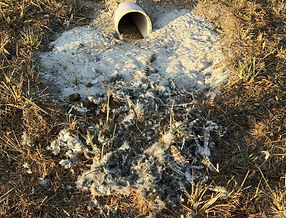
On Nov 25, 2025, unfortunately visibility of owl was increased for the hawk at the artificial burrow with white sand which is not consistent with environmental landscape. Also weed eating was done the day before the incident. Lessons to be learned.
hawk photos by George Padrenoss
Recent press article link: https://bocabeacon.com/burrowing-owl-effort-expands-on-cape-haze/
Video below features Bren Curtis, mentor to Audubon's CLI/FGCU Student Maddie Gonzalez with Audubon Biologist Brittany Piersma banding Owls on Marco Island 2023

Bren Curtis releasing banded BUOW. Audubon Biologist
Brittany Piersma conducted
banding training in
2023.


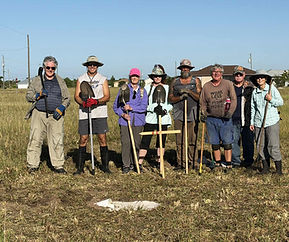
Weedeating Crew

Artificial Burrow Crews


Artificial Burrow Info
Kelly Peluso
Project Perch
https://www.youtube.com/watch?v=o3mE90sYrNg

EYES
Burrowing Owls move their heads to see because their eyes can't move in the sockets like ours do. One pupil appears larger than the other. Their pupil size changes rapidly and independently in each eye to control light, express alertness, or to react to shade.They can rotate their entire necks up to 270 degrees to adjust their field of view. Unlike humans, who rely on involuntary smooth muscles to dilate and constrict pupils, owls possess striated skeletal muscles in their irises. This allows them to change their pupil size consciously and voluntarily. The color can be mismatched and varies: black, yellow, green, amber, brown, gray, speckled & can identify an individual.


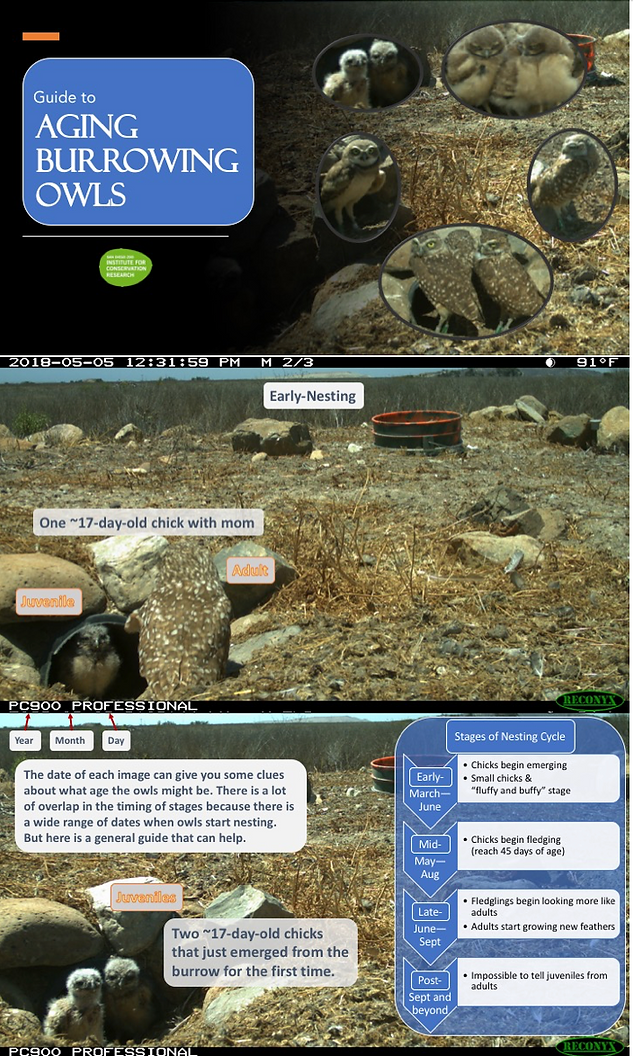
Below: Aging Owlets from 17 to 137 days old
https://www.zooniverse.org/projects/sandiegozooglobal/wildwatch-burrowing-owl/talk/2542/1329972